
Chattahoochee County Jail Release Paths
A Chattahoochee County Jail custody event can end in more than one way. Bond may return a person to the community while the court case continues. Time served may satisfy the jail portion of a sentence. A court may also dismiss a charge, order probation, or direct a transfer. Transfer is crucial: leaving the county jail for the Georgia Department of Corrections, another county, U.S. Marshals, military authorities, or ICE is not the same as being free from custody.
The sheriff's jail record is the first source because Georgia law requires the jailer to record the day of discharge and the order or process that caused it. A court docket can then explain whether the authority was bond, sentence, dismissal, or another order. If the record says transfer, check the named receiving system. The Chattahoochee County released inmate search lays out those county, state, federal, and immigration branches in one sequence.
Confirm Chattahoochee County Jail Release
No official public roster, recent-release feed, twenty-four-hour list, or seventy-two-hour list was found in the reviewed sheriff navigation. That makes direct records access the primary route, not repeated checks of a live feed. Start with enough facts to distinguish the correct booking.
- Call the Chattahoochee County Jail or Sheriff's Office and ask whether the named booking ended in release or transfer.
- Submit the sheriff's open-records form when a written release or discharge record is needed.
- Give the full name, approximate booking date, case number, and date range. Ask for the booking number, release date and time, reason, and transfer notation.
- Check the Chattahoochee County Clerk case record for the bond, disposition, sentence, or other court action behind the release.
- Use GDC, BOP, ICE, Fort Benning, or another county only when the local record points to that custody path.
VINELink can add a custody-change alert when the facility record is available, but an alert does not always state why custody changed. A transfer can trigger a change much like a release. Confirm the legal reason with the sheriff or court instead of treating a notification as the complete discharge record.
Note: The sheriff states that staff respond within three business days with an estimated completion time and estimated cost.
Chattahoochee County Jail Records Contact
The active facility address comes from the official GDC location listing. The sheriff's open-records page uses a nearby Broad Street address for request pickup. Keep those uses distinct: contact the jail about custody and use the records address for a formal request.
379 Broad Street
Cusseta, GA 31805
Phone: 706-989-3644
Chattahoochee County Sheriff's Office records pickup
377 Broad St.
Cusseta, GA 31805
Phone: 706-989-3644
Normal business hours: 8:00 a.m. to 4:30 p.m.
The records form has an "Other" category suited to a release log or discharge record. Its fields accept a date range, case number, incident detail, and other facts. Ask for releasable names and identifiers only for the precise booking or time span needed. The form also has a "Photographs" category, but Georgia law can limit release of booking photos.
Chattahoochee Release Record Fields
Because Chattahoochee County does not publish a release feed, these are request targets rather than promises about a web result. A focused request helps records staff connect the person to one custody episode and apply any lawful redaction.
| Requested field | What it clarifies |
|---|---|
| Booking number and date | Identifies the exact county jail stay. |
| Release date and time | Shows when jail control ended. |
| Release reason or authority | Distinguishes bond, time served, court action, and transfer. |
| Charges and case number | Links the jail event to the court file. |
| Transfer destination | Names the next custody system when applicable. |
Georgia's jail-record law, O.C.G.A. § 42-4-7, calls for the person's identifying details, commitment process, commitment date, discharge day, discharge process, and issuing court. The Georgia Open Records Act supplies the inspection and request framework. Records retained by an agency may still be redacted, restricted, sealed, or protected from public release.
Historic Chattahoochee County Jail
Cusseta has an Old Jail that can appear in local history searches. The New Georgia Encyclopedia county history says the historic jail was built in 1902 and later restored by the Chattahoochee County Historic Preservation Society. It is local history, not the office to use for a present release check.
The current official custody source is the GDC location listing for Chattahoochee County Jail at 379 Broad Street. A search result about the Old Jail should not be read as a current roster, records desk, or release point. Call the active jail number and use the current sheriff form.
Note: The historic jail explains local architecture and history but does not confirm any modern Chattahoochee County release.
Chattahoochee County Jail Custody Boundaries
A county jail booking does not automatically create a GDC offender record. GDC is for Georgia state-prison custody and past state sentences. It may become relevant after a transfer or later prison sentence, but it is not the first lookup for someone who bonded out of Chattahoochee County Jail.
- Bond release
- Jail custody ends under bond authority while the case can remain open.
- Time served
- The custody term required by the sentence or order has been met.
- Discharge
- The administrative end of a custody event, documented by the responsible agency.
- Detainer
- A request or hold that may route the person to another authority instead of the community.
Fort Benning adds another local line. An installation matter may begin with military police rather than the sheriff. Federal criminal custody may then pass through U.S. Marshals and BOP. An immigration detainer may lead to ICE. Each agency keeps its own record, so the county release date only proves when county custody ended.
Chattahoochee Release Request Costs
The sheriff's open-records notice cites O.C.G.A. § 50-18-71. It says research time may be charged at the hourly rate of the lowest-paid full-time employee able to do the work, plus ten cents per page and one dollar per disc or tape. These are record-access costs. Research found no support for calling them jail release fees.
A narrow date range can reduce staff search time. If the court case number is known, add it. The Chattahoochee County Clerk can supply the lasting court context, including a bond order, sentence, dismissal, or probation entry. The jail record and court record answer different questions and work best together.
Once a released person has dropped from any current custody view, keep the written response and note which agency made it. A later GDC, DCS, BOP, or ICE record may show a new stage, not an error in the county release record.
County Release Case Match
Records staff can work more precisely when the request identifies one custody event. Use the full legal name, date of birth if needed, booking date, and court case number. If the exact release date is unknown, give a short range. Ask for the day and time of discharge, the authority that ordered it, and any releasable destination entry. That wording helps tell community release from transfer.
The court check deserves equal care. A bond order means the person left jail while the case continued. A dismissal, plea, sentence, or probation order has a different effect. The clerk file can also show later hearings or warrants that are not part of the original jail discharge. Certification proves the court document's official form, not present custody status.
Recent events may take time to move between systems. Call the jail for the immediate custody fact, preserve the open-records response for written release detail, and use the court docket for the legal cause. If the record identifies a receiving agency, move to that agency's locator. This avoids searches in tools that never covered the county booking.
A final check should state what is known and what is not. The jail record can prove the county discharge date and authority. The court can explain the order. A receiving locator can show later custody. None should be used to guess facts that the source does not contain. If a record is restricted or redacted, ask what releasable confirmation remains available.
Keep dates and agency names in a short timeline: county booking, county discharge, court action, transfer intake, and later release or supervision. This makes two custody events less likely to be merged. It also shows whether the person returned to the community or moved from Chattahoochee County control to another authority.
The official GDC location listing for Chattahoochee County Jail is the source for the active facility address and phone.
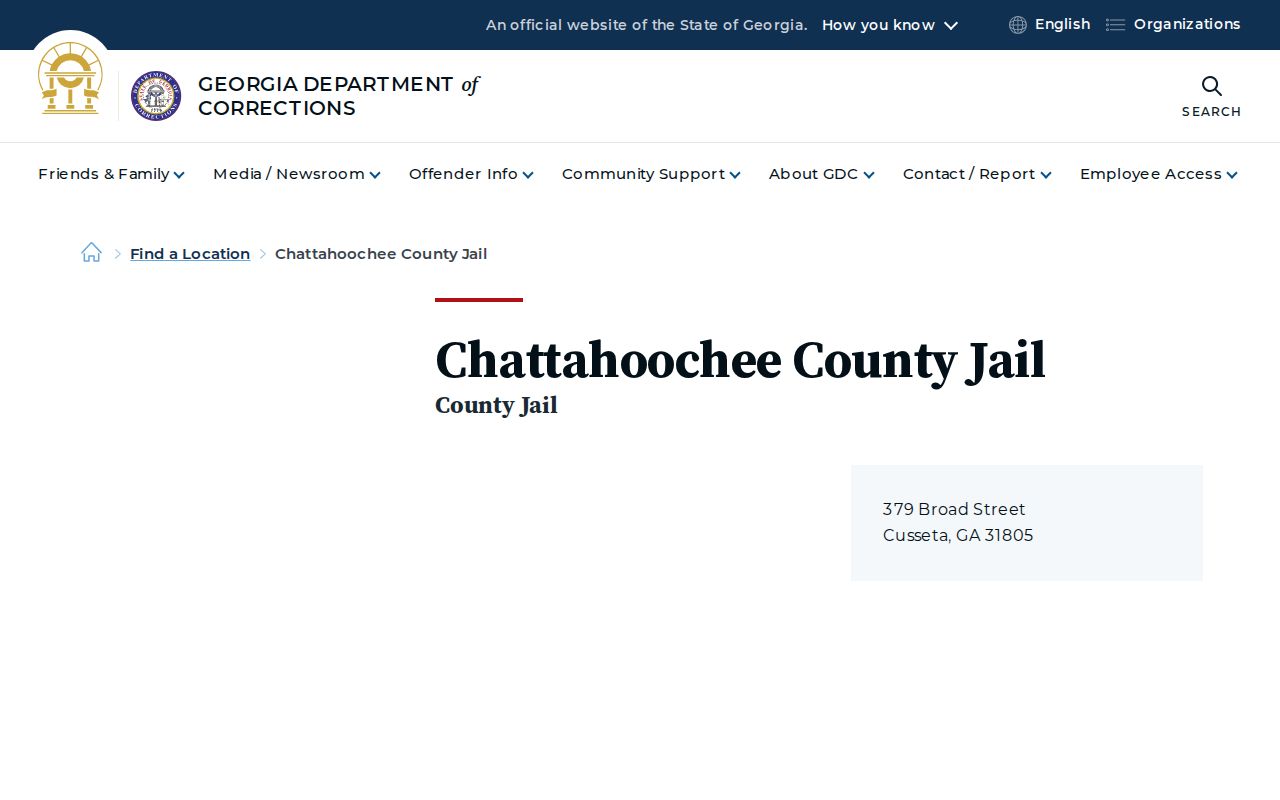
The listing helps distinguish the active jail from the historic Old Jail and directs current release questions to the correct facility.