
Fort Benning Release Paths
Fort Benning covers much of Chattahoochee County, so a local detention question can fall outside the sheriff's normal jail stream. The Directorate of Emergency Services, or DES, includes Military Police Operations. Its duties include patrols, desk operations, emergency dispatch, and response on the installation. A person who was stopped, cited, or briefly held there may never enter Chattahoochee County Jail.
The first question is which agency took control after the military police contact. A person may be released by the installation authority, delivered to a civilian local agency, or placed in federal criminal custody. U.S. Marshals generally house and transport federal prisoners from initial federal custody through trial and, if sentenced, onward to the Bureau of Prisons. County, military, Marshals, and BOP records are separate.
Confirm Fort Benning Release
Begin with the details of the installation event: full name, date, location, agency, and any citation or case number. The DES or MP Desk can help route a question about an on-post law-enforcement contact. It is not a public past-inmate database, and it should not be treated as a recent-release feed.
- Ask the Fort Benning MP Desk whether the matter stayed with military police or was handed to another authority.
- If Chattahoochee County Jail received the person, call the sheriff and request the county release or transfer record.
- If a federal court matter followed, use the court record to identify bond, remand, acquittal, sentence, or transfer.
- For a federal sentence, search the BOP inmate locator by name or federal register number.
- When another agency still has custody, confirm status with that agency rather than calling the handoff a community release.
The Chattahoochee County release search paths can help separate county jail, state prison, federal, ICE, and supervision records. A live locator answers current status. A court order or agency record is needed to explain why custody ended or changed.
Note: U.S. Marshals custody is a federal holding and transport channel, not a public county release list.
Fort Benning Police Contact
The official Fort Benning DES page is the source for the installation police channel and its contact numbers. Use it for a matter that began on post, then follow the named receiving agency if the person was transferred.
Military Police Operations / MP Desk
Non-emergency: 706-545-5222
Also listed: 706-545-5223 and 706-545-5224
Desk Sergeant: 706-905-5644
The source does not present the DES as a jail or publish an inmate release roster. The contact card is therefore a routing point. Do not ask the county sheriff to confirm an event that never entered county custody, and do not search GDC unless a Georgia state-prison sentence is involved.
The official DES view below helps identify the installation agency. It does not itself prove that a named person was released.
View the Fort Benning Directorate of Emergency Services source.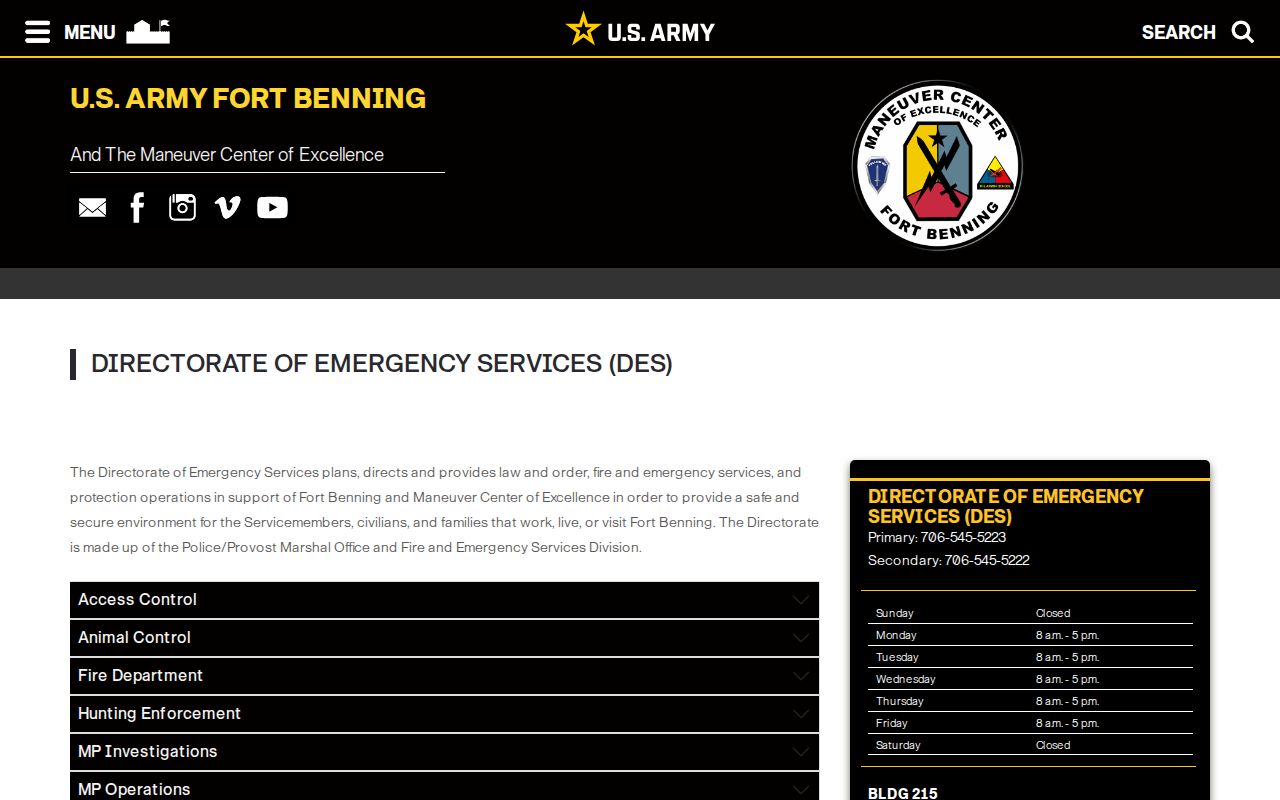
The displayed page supports the MP Desk route used when a Chattahoochee County question began on the installation.
Fort Moore Name Searches
Older records and searches may call the installation Fort Moore. The post used that name from 2023 until a 2025 renaming directive restored Fort Benning. Current copy and current contacts should use Fort Benning, while name searches may need both terms to find older court dockets, news entries, or agency references.
The Army account of the restoration of the Fort Benning name provides the official naming context. It prevents a mistaken conclusion that Fort Moore and Fort Benning are different custody sites.

The name change explains why records from the same installation can appear under two place names.
Note: Use the event date to choose the likely name, but search both names when an older result is hard to locate.
Fort Benning Federal Custody
A federal defendant may be released on bond by the court or remanded, meaning ordered held, in U.S. Marshals custody. The Marshals Service states that federal courts decide whether defendants are released or detained. The Marshals then arrange detention placement and transport, often through contract facilities, until acquittal or placement in prison.
| Stage | Best confirmation source |
|---|---|
| Installation police contact | Fort Benning DES / MP Desk |
| County jail handoff | Chattahoochee County sheriff release record |
| Federal pretrial custody | Federal court docket and U.S. Marshals routing |
| Federal sentence | BOP inmate locator and BOP records |
| Community supervision | Federal court or probation office identified in the case |
The Marshals do not provide a public release roster. Their prisoner policy also limits disclosure of personal histories and photographs. A caller should use the court case for the legal outcome and BOP only when a federal prison record exists.
Fort Benning Custody Distinctions
GDC is not a catch-all search for Fort Benning cases. It applies when a person enters Georgia state-prison custody. Chattahoochee County Jail applies only when the sheriff received the person. BOP covers federal inmates, while ICE covers immigration detention. Military justice may use still other official channels based on status and the proceeding.
- Release
- The responsible authority ends its custody, though supervision or another case may continue.
- Transfer
- Control passes to another agency, so the person may remain confined.
- Remand
- A court orders a defendant held rather than released on bond.
- Detainer
- An authority asks that a person be held or transferred when present custody ends.
A record stating "not here" proves only that one agency lacks current custody. It does not identify the next agency. Follow the transfer entry, court docket, or receiving-system record to close that gap.
Fort Benning Record Requests
The correct request depends on the record creator. Ask DES about an installation police incident. Ask the sheriff for a county jail discharge only if the jail accepted the person. Seek federal court records for bond, detention, disposition, and sentence. Use BOP records for federal prison custody and release dates.
Frame the request around one event. Include the full name, date, location, citation or case number, and known receiving agency. Ask whether the event ended in release or transfer and request the releasable document that records that outcome. A narrow request is easier to route than a broad demand for every record tied to a name.
Fort Benning's unusual local footprint makes this agency check essential. Chattahoochee County geography does not make every on-post detention a county jail matter. Confirm the agency first, then use its release record and the court record that supports it.
Fort Benning Case Matching
A citation without booking may produce no jail discharge. A transfer to the sheriff should create a county custody entry, while federal remand should appear in the federal docket. If military authority handled the matter, the process can differ again. Do not infer the forum from location alone. Ask which report number, court, or receiving agency applies.
Dates can expose the right path. Match the incident date to the installation name used then, compare the court filing date, any Marshals stage, and a later BOP entry. A gap may reflect pretrial release or detention outside BOP. The federal court record is the durable source for bond, detention, disposition, and sentence actions.
For present status, use the agency that actually has control. DES handles installation police routing. The county jail confirms only its own custody. BOP confirms federal prison status. ICE confirms immigration detention. Keeping those roles separate protects the meaning of each release date and makes an older Fort Moore reference easier to reconcile.
A Fort Benning records request should avoid calling DES a detention facility. Ask for the releasable incident or desk record and the receiving authority. If the person was cited and released, the citation and court file may be the only durable public trail. If the sheriff received the person, the county jail discharge becomes a separate event with its own date.
When BOP returns no match, do not claim release. A federal defendant may have been on bond, held by Marshals outside BOP, acquitted, or never sentenced to federal prison. Search the federal docket and compare identity. The docket can show the order that no prison locator will show.
Military and civilian status can affect which office keeps a record. Identify the agency, case forum, and handoff. The best Fort Benning custody timeline lists each authority in sequence and preserves the difference between release from one stage and release from all confinement.
Always record the exact agency name given by the MP Desk.