
ICE Transfer Release Path
An immigration detainer can change where a person goes when county, state, or federal custody ends. Chattahoochee County Jail may record a release or transfer because its own custody closed, while ICE becomes the next authority. That is not the same as a community release.
The ICE Online Detainee Locator System, or ODLS, is designed to locate a person currently in ICE custody. USA.gov also describes it as a route for someone in ICE custody or who has been in CBP custody for more than forty-eight hours. It does not replace the sheriff's discharge record, GDC release field, or BOP release result.
Search ICE Detainee Status
The official ICE Online Detainee Locator offers two identity routes. The A-number path uses the immigration file number and country of birth. The biographical path uses name, country of birth, and birth date.
- Gather the person's full name as ICE may record it, country of birth, birth date, and A-number if known.
- Search by A-number and country of birth first when the number is available.
- Otherwise use the name and biographical route, checking spelling order and hyphenated or multiple surnames.
- Read the result only as an ICE custody or locator status.
- Confirm the prior transfer with Chattahoochee County Jail, GDC, BOP, or the court that recorded the handoff.
- Use official ICE or USA.gov help when no result appears despite reliable transfer information.
An A-number is often the strongest key because names can be entered in more than one form. Do not guess a country of birth. A failed search may result from spelling, data timing, age limits, custody stage, or the fact that ICE never received the person.
Note: ICE status does not state the full reason the prior jail or prison custody ended.
ICE Locator Search Fields
ODLS asks for specific identity combinations. The field sets should not be mixed with county booking numbers, GDC IDs, or BOP register numbers. Those identifiers belong to the originating systems and help confirm the transfer separately.
| Search route | Required identity details |
|---|---|
| A-number search | A-number and country of birth |
| Biographical search | Name, country of birth, and birth date |
| County transfer check | Name, booking number, release date, and transfer destination |
| State or federal check | GDC ID or BOP register number plus release status |
If ODLS finds the person, record the exact name form and the date checked. Then compare it to the prior agency record. The two sources answer different questions: one shows local, state, or federal custody ending; the other addresses ICE detention.
ICE Status Help Source
The public ICE locator does not provide a Chattahoochee County office card because it is a nationwide federal tool. The official search and the federal help route are the appropriate contacts for a detainee-location question.
Nationwide immigration custody locator
Search with A-number and country of birth
Or search by name, country of birth, and birth date
Official help: ICE and USA.gov detainee guidance
The USA.gov guide to locating a person detained by ICE provides a successful manifest view of the official process.
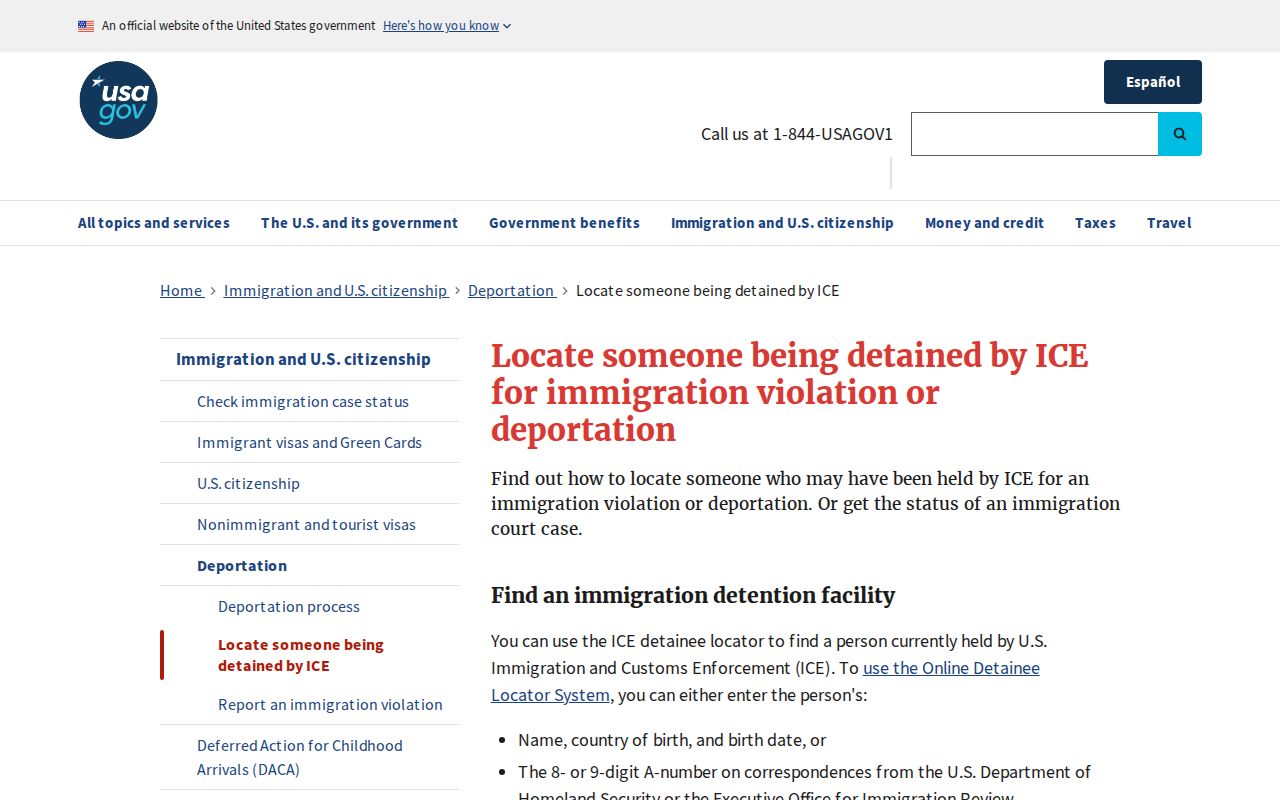
The guide supports the identity fields and federal assistance route when the locator does not settle the question.
Note: The ICE locator itself could not be captured in the manifest, so no failed or mismatched image is used.
County Release Versus ICE
Chattahoochee County has no official public recent-release feed in the reviewed sheriff navigation. For a suspected ICE handoff, call the jail or submit the sheriff's open-records form. Ask for the release or discharge record, including the release reason and transfer destination if releasable.
The county record should be framed around one booking. Provide the full name, approximate booking date, case number, and date range. The sheriff states that staff respond within three business days with estimated completion time and cost. A response showing transfer to immigration authorities explains why the person left county custody but did not return home.
| Record | What it proves |
|---|---|
| County jail discharge | When and why Chattahoochee County custody ended |
| ICE locator result | Current or recent immigration custody information |
| Court docket | Bond, disposition, sentence, or other court action |
| VINELink alert | A custody change, not necessarily a community release |
The Chattahoochee County Jail release page explains how to request the local discharge record. Use it alongside ODLS when the handoff began at the county jail.
ICE Detainer Meaning
A detainer is a request or notice that can affect what happens when another agency is ready to release a person. It may lead to a transfer rather than release to the community. The exact legal effect depends on the case and the agencies involved, so the public record should be read without assumptions.
- Detainer
- A request tied to a person held by another authority, often affecting the next custody step.
- Transfer
- The move from one agency's control to another agency's control.
- Community release
- The person leaves secure custody rather than moving to another detention authority.
- A-number
- An immigration file identifier used by the ICE locator.
ODLS is not a release-reason database. It may locate detention but does not replace the prior agency's transfer notation. Keep both records when trying to reconstruct the custody path.
ICE and Federal Custody
A BOP result saying "Released" or "Not in BOP Custody" can coexist with ICE custody. BOP reports only its own control. Likewise, a U.S. Marshals or federal court record can show the end of federal criminal detention while immigration custody starts.
Fort Benning adds a local federal layer. An on-post matter may begin with military police, pass to U.S. Marshals, and later reach BOP or ICE depending on the case. Chattahoochee County Jail may never be involved. Start with the agency named in the first reliable record, then follow each documented handoff.
GDC has the same boundary. An actual state-prison release date proves the GDC event ended. If the offender sheet, prison record, or other official notice points to an immigration transfer, ODLS becomes the next check.
Note: No one locator combines county, state, military, federal criminal, and immigration custody.
ICE Search Result Limits
A no-result screen does not prove community release. Data can lag, identity details may differ, and some people may fall outside the public locator's coverage. Recheck spelling and the A-number, then use official assistance and the prior agency's record.
Do not treat a locator result as a court disposition or immigration case decision. Those legal records come from the responsible court or agency. ODLS answers the narrower location and custody question.
The clearest Chattahoochee County workflow has two parts: obtain the originating release or transfer record, then search ICE with accurate identity details. If ICE shows custody, the county release was an agency handoff. If ICE does not show custody, request official clarification rather than guessing from the missing result.
ICE Identity Match Checks
Name order and spelling matter in ODLS. Compare all surnames, birth date, country of birth, and the full A-number. Keep the prior agency's booking or offender number nearby, but do not enter it as though it were an immigration identifier.
If a reliable transfer record and locator disagree, note the date and contact official ICE help. Custody data can change after a move or release. The originating record proves its own handoff, while ICE must explain its current system. Neither record should be stretched beyond the agency and date it covers.
A county open-records response helps when ODLS shows no result. Ask whether discharge was to an agency and whether a destination is releasable. If the sheriff records community release, the ICE search may concern a different event. Match the booking number and date first.
A GDC or BOP release date can precede ICE intake. The prison locator is still correct about its custody. Build a timeline with the release date, transfer notation, and ICE lookup date. That explains why two official tools can show different status.
Immigration detention can change. Recheck ODLS with the same fields when official notice indicates movement. Save the A-number exactly. If the locator stays unclear, use official federal help rather than a third-party mirror or an inference from silence.
When the person has more than one surname or a changed name, test only accurate variations supported by official records. Do not omit the birth-country check or substitute nationality. A careful identity match is essential because ODLS is being used to connect a later immigration stage to a specific Chattahoochee County custody event.